
 Undergraduate Student, UW CSE
Hey there! My name is Brian and I am a second-year Computer Science undergrad at the University of Washington, where I am fortunate to work on research with Prof. Noah Smith. I will be visiting the University of California, Berkeley as a visiting student researcher, advised by Prof. Sewon Min. I am broadly interested in natural language/music processing.
On the industry side, I am currently a Member of Technical Staff Intern at OpenAI. Previously, I was a Backend Engineering Intern at Robinhood, and did research at EleutherAI.
I was originally from Vancouver, Canada, and have spent time in Toronto and Shanghai before settling down in Seattle. While not doing research, you can usually find me hiking or bouldering.
Warning
Problem: The current name of your GitHub Pages repository ("Solution: Please consider renaming the repository to "
http://".
However, if the current repository name is intended, you can ignore this message by removing "{% include widgets/debug_repo_name.html %}" in index.html.
Action required
Problem: The current root path of this site is "baseurl ("_config.yml.
Solution: Please set the
baseurl in _config.yml to "Education
-
University of WashingtonPaul G. Allen School of Computer Science and Engineering
Undergraduate StudentSep. 2024 - present
Honors & Awards
-
Mary Gates Research Scholarship2025
-
ICPC Pacific Northwest Regionals2024
-
Meta Hacker Cup Round 2 Qualifier2024
Service
-
Served as Reviewer for ICLR 2026
-
Served as Reviewer for NeurIPS 2026
News
Selected Publications (view all )
LEGATO 2: Toward Multimodal Sheet Music Recognition and Understanding
Guang Yang*, Brian Siyuan Zheng*, Victoria Ebert, Noah A. Smith (* equal contribution)
arXiv preprint 2026
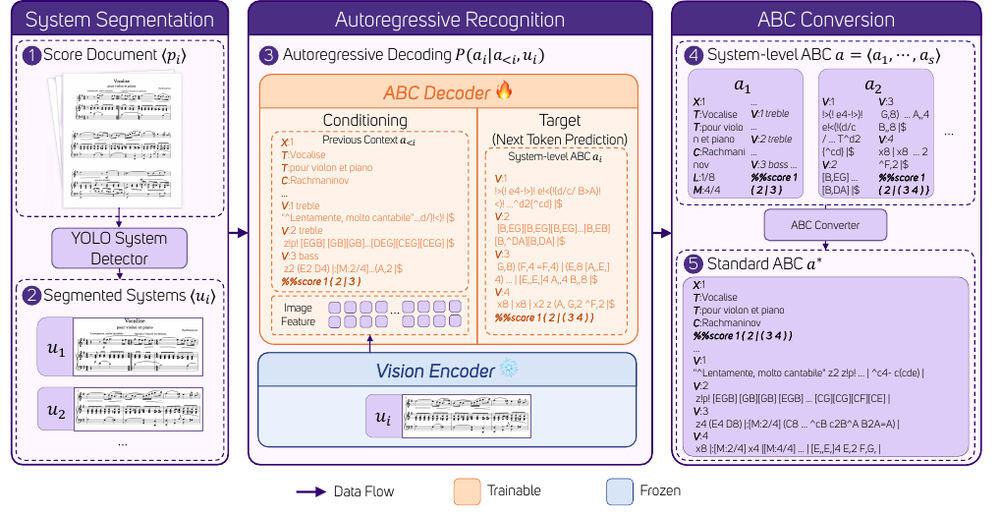
We propose a novel pipeline, Legato 2, for extracting symbolic notation and semantic knowledge from images of sheet music. Legato 2 features the first large-scale neural model for optical music recognition (OMR) to operate sequentially on a system-by-system basis, following the horizontal lines of notation as they are read on the page, rather than treating the page as an undifferentiated image, enabling better scaling to arbitrarily long inputs. It is also the first OMR model capable of generating symbolic transcriptions that include embedded textual content, such as titles and annotations. The pipeline combines system-level segmentation with an autoregressive vision-LM to capture both local notation details and score structure. Across multiple datasets, Legato 2 consistently outperforms prior state of the art. We also show that symbolic transcriptions complement visual inputs for frontier language models, improving their interpretation of dense musical documents. Legato 2 establishes new state-of-the-art performance in both OMR and downstream sheet music understanding.
LEGATO 2: Toward Multimodal Sheet Music Recognition and Understanding
Guang Yang*, Brian Siyuan Zheng*, Victoria Ebert, Noah A. Smith (* equal contribution)
arXiv preprint 2026
We propose a novel pipeline, Legato 2, for extracting symbolic notation and semantic knowledge from images of sheet music. Legato 2 features the first large-scale neural model for optical music recognition (OMR) to operate sequentially on a system-by-system basis, following the horizontal lines of notation as they are read on the page, rather than treating the page as an undifferentiated image, enabling better scaling to arbitrarily long inputs. It is also the first OMR model capable of generating symbolic transcriptions that include embedded textual content, such as titles and annotations. The pipeline combines system-level segmentation with an autoregressive vision-LM to capture both local notation details and score structure. Across multiple datasets, Legato 2 consistently outperforms prior state of the art. We also show that symbolic transcriptions complement visual inputs for frontier language models, improving their interpretation of dense musical documents. Legato 2 establishes new state-of-the-art performance in both OMR and downstream sheet music understanding.
LEGATO: Large-Scale End-To-End Generalizable Approach to Typeset OMR
Guang Yang, Victoria Ebert, Nazif Tamer, Brian Siyuan Zheng, Luiza Pozzobon, Noah A. Smith
International Conference on Learning Representations (ICLR) 2026 2026
We propose Legato, a new end-to-end model for optical music recognition (OMR), a task of converting music score images to machine-readable documents. Legato is the first large-scale pretrained OMR model capable of recognizing full-page or multi-page typeset music scores and the first to generate documents in ABC notation, a concise, human-readable format for symbolic music. Bringing together a pretrained vision encoder with an ABC decoder trained on a dataset of more than 214K images, our model exhibits the strong ability to generalize across various typeset scores. We conduct comprehensive experiments on a range of datasets and metrics and demonstrate that Legato outperforms the previous state of the art. On our most realistic dataset, we see a 68% and 47.6% absolute error reduction on the standard metrics TEDn and OMR-NED, respectively.
LEGATO: Large-Scale End-To-End Generalizable Approach to Typeset OMR
Guang Yang, Victoria Ebert, Nazif Tamer, Brian Siyuan Zheng, Luiza Pozzobon, Noah A. Smith
International Conference on Learning Representations (ICLR) 2026 2026
We propose Legato, a new end-to-end model for optical music recognition (OMR), a task of converting music score images to machine-readable documents. Legato is the first large-scale pretrained OMR model capable of recognizing full-page or multi-page typeset music scores and the first to generate documents in ABC notation, a concise, human-readable format for symbolic music. Bringing together a pretrained vision encoder with an ABC decoder trained on a dataset of more than 214K images, our model exhibits the strong ability to generalize across various typeset scores. We conduct comprehensive experiments on a range of datasets and metrics and demonstrate that Legato outperforms the previous state of the art. On our most realistic dataset, we see a 68% and 47.6% absolute error reduction on the standard metrics TEDn and OMR-NED, respectively.
.png)
Broken Tokens? Your Language Model can Secretly Handle Non-Canonical Tokenizations
Brian Siyuan Zheng, Alisa Liu, Orevaoghene Ahia, Jonathan Hayase, Yejin Choi, Noah A. Smith
Conference on Neural Information Processing Systems (NeurIPS) 2025 Spotlight (Top 3%)
Modern tokenizers employ deterministic algorithms to map text into a single “canonical” token sequence, yet the same string can be encoded as many noncanonical tokenizations using the tokenizer vocabulary. In this work, we investigate the robustness of LMs to text encoded with non-canonical tokenizations entirely unseen during training. Surprisingly, when evaluated across 20 benchmarks, we find that instruction-tuned models retain up to 93.4% of their original performance when given a randomly sampled tokenization, and 90.8% with character-level tokenization. We see that overall stronger models tend to be more robust, and robustness diminishes as the tokenization departs farther from the canonical form. Motivated by these results, we then identify settings where non-canonical tokenization schemes can improve performance, finding that character-level segmentation improves string manipulation and code understanding tasks by up to +14%, and right-aligned digit grouping enhances large-number arithmetic by +33%. Finally, we investigate the source of this robustness, finding that it arises in the instructiontuning phase. We show that while both base and post-trained models grasp the semantics of non-canonical tokenizations (perceiving them as containing misspellings), base models try to mimic the imagined mistakes and degenerate into nonsensical output, while post-trained models are committed to fluent responses. Overall, our findings suggest that models are less tied to their tokenizer than previously believed, and demonstrate the promise of intervening on tokenization at inference time to boost performance.
Broken Tokens? Your Language Model can Secretly Handle Non-Canonical Tokenizations
Brian Siyuan Zheng, Alisa Liu, Orevaoghene Ahia, Jonathan Hayase, Yejin Choi, Noah A. Smith
Conference on Neural Information Processing Systems (NeurIPS) 2025 Spotlight (Top 3%)
Modern tokenizers employ deterministic algorithms to map text into a single “canonical” token sequence, yet the same string can be encoded as many noncanonical tokenizations using the tokenizer vocabulary. In this work, we investigate the robustness of LMs to text encoded with non-canonical tokenizations entirely unseen during training. Surprisingly, when evaluated across 20 benchmarks, we find that instruction-tuned models retain up to 93.4% of their original performance when given a randomly sampled tokenization, and 90.8% with character-level tokenization. We see that overall stronger models tend to be more robust, and robustness diminishes as the tokenization departs farther from the canonical form. Motivated by these results, we then identify settings where non-canonical tokenization schemes can improve performance, finding that character-level segmentation improves string manipulation and code understanding tasks by up to +14%, and right-aligned digit grouping enhances large-number arithmetic by +33%. Finally, we investigate the source of this robustness, finding that it arises in the instructiontuning phase. We show that while both base and post-trained models grasp the semantics of non-canonical tokenizations (perceiving them as containing misspellings), base models try to mimic the imagined mistakes and degenerate into nonsensical output, while post-trained models are committed to fluent responses. Overall, our findings suggest that models are less tied to their tokenizer than previously believed, and demonstrate the promise of intervening on tokenization at inference time to boost performance.